What to buy, how much, and in what order — a shelf-stable list for a household that wants a reserve it will actually eat.
Shopping list and planning quantities, not a nutrition plan. The dry-food estimate and child weights come from the calculator; shelf-life windows are checked against USDA sources.
Quick answer
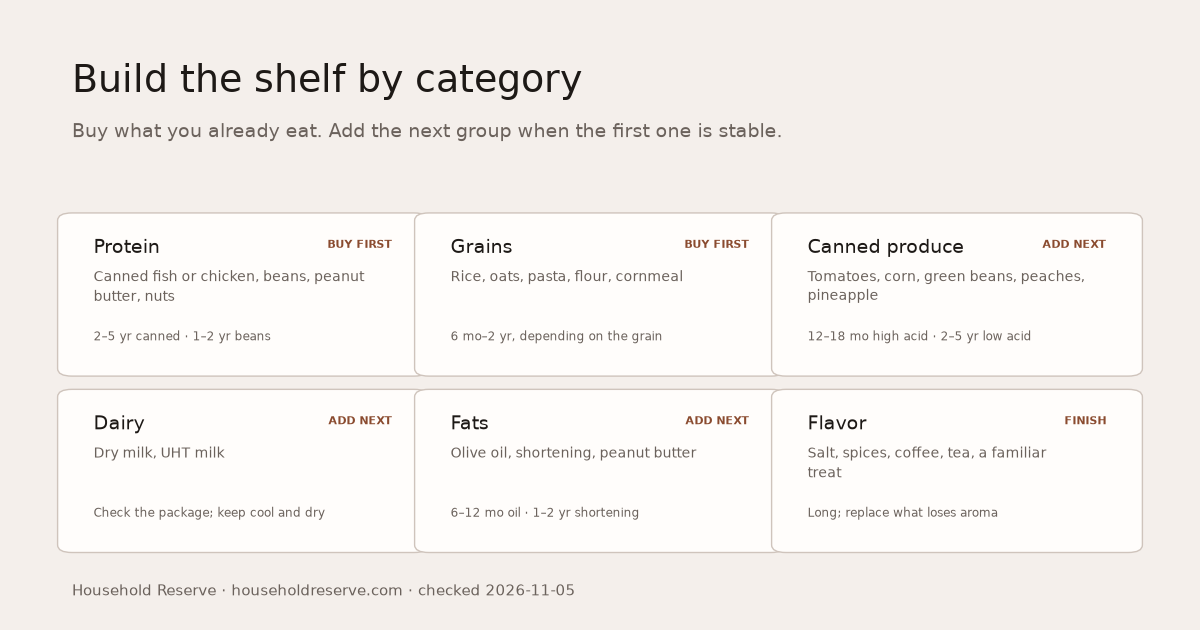
Build the list by category: protein, grains, canned produce, dairy, fats, and flavor. Buy foods you already eat; aim for 1.5 lb of dry staples per person-day and add canned protein and produce separately. A four-person, three-month reserve is 540 lb of dry staples at the planning rate.
The list is not a brand guide. It is a structure for buying the gap in weeks, with a shelf life you can rotate instead of a closet you forget.
The list by category
Start with the first two groups, then add the rest as the shelf becomes stable. The priority column is a buying order, not a nutrition ranking.
A practical non-perishable list. Shelf life is for an intact, unopened package in cool, dry storage.
The buying order: protein and grains first, then produce, dairy, and fats, then flavor and comfort.
How much to buy
The table uses the calculator’s planning rates for an all-adult household: 1.5 lb of dry food and $3 per adult-equivalent person-day, and 1 gallon of water per person per day. The calculator handles children.
Dry food, water, and budget baseline by household and horizon. Rounded to whole pounds, gallons, and dollars.
Household
Person-days
Dry food
Water
Budget
1 month
2 people
60
90 lb
60 gal
$180
4 people
120
180 lb
120 gal
$360
6 people
180
270 lb
180 gal
$540
3 months
2 people
180
270 lb
180 gal
$540
4 people
360
540 lb
360 gal
$1,080
6 people
540
810 lb
540 gal
$1,620
6 months
2 people
360
540 lb
360 gal
$1,080
4 people
720
1,080 lb
720 gal
$2,160
6 people
1,080
1,620 lb
1,080 gal
$3,240
What 540 lb looks like
The free calculator splits the dry weight into six planning categories. For four adults over three months:
The six-category split for four adults over three months. This is a weight plan, not a USDA nutrition basket.
Category
Pounds
Typical foods
Grains
390 lb
Rice, Oats, Pasta, Flour, Cornmeal
Legumes
58 lb
Dry beans, Lentils, Split peas
Sugar
58 lb
Sugar, Honey, Syrup
Dry milk
16 lb
Nonfat dry milk
Fats and oils
10 lb
Cooking oil, Shortening, Peanut butter
Salt
8 lb
Table salt
Canned protein, canned produce, and other food groups are added on top of the dry-staple number. The calculator shows the split for your household.
What not to buy
Food you do not normally eat. A five-gallon bucket of something unfamiliar is not a reserve; it is a future donation.
Damaged cans. Bulging, leaking, rusted, or deeply dented cans are not a bargain.
Giant packages you cannot rotate. A 50-pound bag is cheap per pound and expensive per wasted pound if it sits in a hot garage.
Perishable food disguised as a plan. Fresh produce, frozen meals, and refrigerated food depend on power; they are not the base of a shelf-stable reserve.
Salt-heavy snacks as staples. They do not replace protein, grains, or produce.
Store it so you can eat it
Keep the shelf cool, dark, dry, and off the floor. Date every lot and put the oldest in front. Use the long-term food storage guide for shelf life and containers, and the pantry inventory for the monthly check.
Start with foods your household already eats: canned fish or chicken, beans, lentils, peanut butter, rice, oats, pasta, flour, canned vegetables and fruit, dry milk, oil, salt, and spices. Add a manual can opener and a way to cook. Variety matters more than a single “perfect” food.
How much non-perishable food should I store per person?
At the planning rate, one adult needs 45 lb of dry staples per month, 135 lb for three months, and 270 lb for six months. Water is 30 gallons per person per month. Canned protein, canned produce, and foods for children or special diets are added separately.
Do canned foods count as non-perishable?
Yes. Low-acid canned goods such as meat, beans, corn, peas, and soup keep 2 to 5 years; high-acid canned goods such as tomatoes, fruit, and pickles keep 12 to 18 months. They add water weight and volume, so the dry-staple estimate tracks them separately.
What should I buy first?
Water, dry grains, legumes, and a manual can opener. Then canned protein, fats, canned produce, dry milk, and flavor. Buy one week at a time in the order you will eat, so the shelf rotates instead of becoming clutter.
How long does a non-perishable food list last?
It depends on the food and the storage. White rice and dry pasta are about 2 years, flour 6–12 months, oats 12 months, dried beans 1–2 years, and low-acid canned goods 2–5 years. Keep the shelf cool, dark, dry, and sealed; rotate the oldest first.
Sources and assumptions
The shelf-life windows are from USDA FSIS and FoodKeeper, checked 2026-11-05. The quantities are the site’s planning rates, not a government standard.
External sources used on this page. Open a source to read the current version.