How much water to store, which containers are safe, and how to clean, rotate, and treat it when the tap stops working.
Quantities use Ready.gov’s 1 gallon per person per day. Treatment follows Ready.gov, CDC, and EPA; checked 2026-11-05. When in doubt, use bottled or boiled water.
Quick answer
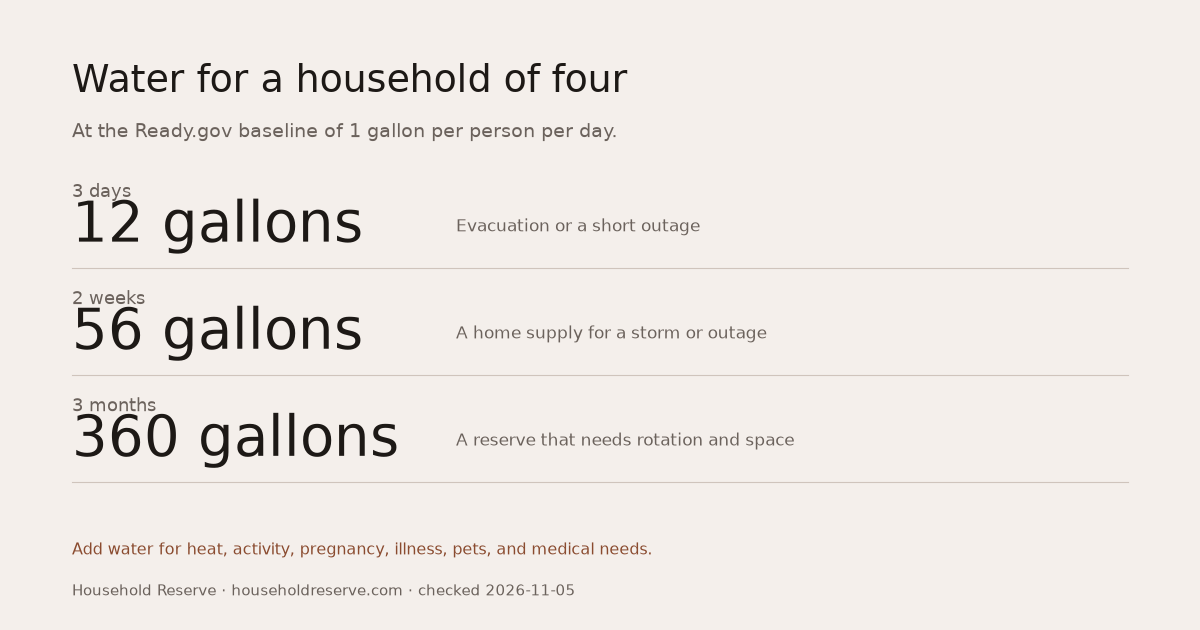
Store at least 1 gallon per person per day. Three days is an evacuation supply; two weeks is a home supply; three months is a reserve. A four-person household needs 12, 56, or 360 gallons. Use food-grade containers, keep them cool and dark, and replace self-filled water every 6 months.
Water is heavier and harder to move than food. Store it where you can reach it, in containers you can lift, and rotate it before it becomes a science project.
How much water to store
The table uses 1 gallon per person per day for drinking and basic sanitation. It does not include water for pets, cooking, or medical needs; add those separately.
Gallons of water at the Ready.gov baseline. Three days is for evacuation; two weeks is a home supply; three months is a reserve.
Household
3 days
2 weeks
3 months
1 person
3 gal
14 gal
90 gal
2 people
6 gal
28 gal
180 gal
4 people
12 gal
56 gal
360 gal
6 people
18 gal
84 gal
540 gal
A four-person household at the Ready.gov baseline. Add water for heat, activity, pregnancy, illness, pets, and medical needs.
Containers that are actually food-safe
The container matters as much as the water. Use food-grade plastic, glass, or metal that is made for drinking water; avoid anything that held chemicals, and avoid containers that are hard to clean.
Water container options. “Food-grade” means the container is made for food or drinking water, not just any sturdy plastic.
Container
Best for
Strengths
Watch out
Commercial bottled water
Short- and medium-term
Sealed, food-grade, easy to move
Check the date; store cool and dark; do not open until needed
Food-grade barrel (55 gal)
Stationary home reserve
Large volume, strong container
Very heavy; needs a pump or spigot; clean and sanitize before filling
Stackable water containers
Home reserve with limited space
Stackable, movable, made for water
Cost; clean and dry between fills; follow the maker's instructions
Bathtub bladder
Short-term, before an outage
Fits a tub, stores a large volume quickly
Not a long-term container; fill before the storm, use within days
Glass jars
Small amounts
Inert, easy to clean, visible
Breakable and heavy; store out of light and away from edges
Food-grade #2 HDPE jugs
Small amounts you rotate
Cheap, available, easy to carry
Not every jug is food-grade; milk jugs degrade and are not for storage
Cleaning, filling, and rotation
Commercially bottled water is the simplest option: keep it sealed in the original container, in a cool, dark place, and check the date. If you fill your own containers, use food-grade containers and clean them first.
Ready.gov’s cleaning steps: wash the container with dish soap, then sanitize it with a solution of 1 teaspoon of unscented liquid household chlorine bleach to 1 quart of water. Fill with chlorinated tap water, label the date, and replace the water every 6 months.
Keep containers off concrete floors and out of sunlight.
Do not stack heavy barrels on a weak shelf or floor.
Use the oldest water first and refill the container; do not let a reserve sit for years.
Keep a cup or pump with the container so you do not contaminate the water with dirty hands.
Treating water when you run out
Treat all water of uncertain quality before drinking, cooking, washing dishes, brushing teeth, or making ice. Let suspended particles settle or strain them through a clean cloth first.
Boiling
Boiling is the safest method. Bring the water to a rolling boil for 1 full minute, then let it cool. Boiled water tastes flat; pour it between two clean containers to add air back.
Disinfection
If you cannot boil, Ready.gov and EPA describe disinfection with plain unscented household bleach containing 5.25–6.0% sodium hypochlorite. Ready.gov’s amount is 1/8 teaspoon per gallon; stir and let it stand for 30 minutes. The water should have a slight bleach odor. If it does not, repeat the dose and wait another 15 minutes. Do not use scented, color-safe, or bleach with added cleaners.
Filters and purification devices must be rated for the contaminants you are concerned about; follow the manufacturer’s instructions. When in doubt, use bottled or boiled water.
Pets, cooking, and sanitation
Add water for pets, cooking, and basic sanitation. A reserve that only covers drinking water will run short if the tap is out for days. Keep a separate small bottle for handwashing and cleaning, and do not dip dirty cups into the main container.
Emergency water questions
How much water should I store per person?
At least 1 gallon per person per day for drinking and basic sanitation. That is 3 gallons for 3 days, 14 gallons for 2 weeks, and 90 gallons for 3 months. Heat, activity, pregnancy, illness, pets, and medical needs can raise the amount.
How often should I replace stored water?
Commercially bottled water stays sealed in its original container; check the date. Water you fill yourself should be replaced every 6 months, according to Ready.gov. Label the fill date and rotate it like food.
What containers are safe for drinking water?
Use food-grade containers: commercial bottled water, food-grade barrels, stackable water containers, or clean glass jars. Avoid containers that held chemicals, milk jugs that degrade, and any plastic not labeled food-grade.
Can I use milk jugs for water storage?
No. Milk jugs are designed for short refrigerated use, are hard to clean, and degrade. They can leak or contaminate the water. Use a food-grade water container instead.
How do I treat water in an emergency?
Boiling is the safest method: bring water to a rolling boil for 1 minute, then cool. If you cannot boil, Ready.gov and EPA describe disinfection with plain unscented household bleach; follow their amounts and wait times. Filters must be rated for the contaminants you are concerned about. When in doubt, use bottled or boiled water.
Sources and assumptions
Quantities and treatment steps are from Ready.gov, CDC, and EPA, checked 2026-11-05. This page does not cover medical hydration advice.
External sources used on this page. Open a source to read the current version.
At least 1 gallon per person per day; store bottled water sealed; clean and sanitize food-grade containers; replace self-filled water every 6 months; boil 1 minute or disinfect.