What stays safe, what to throw out, and what to eat when the power is off and you cannot cook.
Food-safety times and temperatures are from USDA, FDA, and the Red Cross, checked 2026-11-05. This page is not medical advice. When in doubt, throw it out.
Quick answer
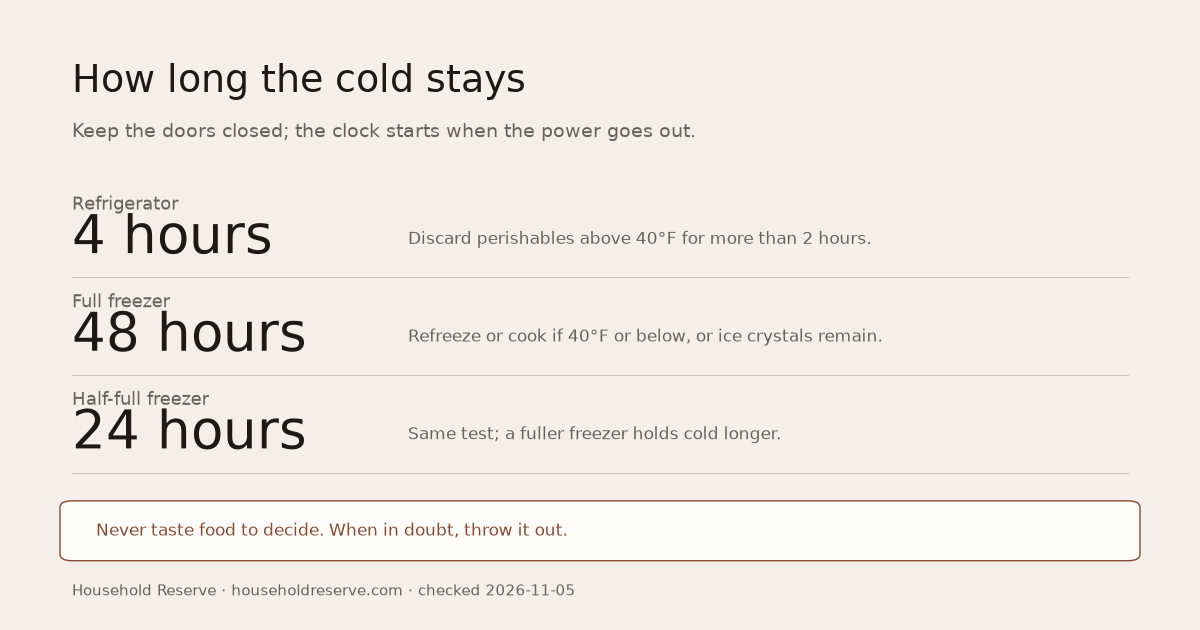
Keep the doors closed. An unopened refrigerator keeps food cold for about 4 hours. A full freezer holds about 48 hours; a half-full freezer about 24. Discard perishables that were above 40°F for more than 2 hours. Never taste food to decide whether it is safe.
A power outage is a food-safety problem before it is a recipe problem. The first hour is about keeping the cold in; the next day is about using shelf-stable food and a manual can opener.
How long does food last in the fridge without power?
The answer depends on the appliance, how full it is, and how often the door opens. These are the official planning times, not a guarantee.
Refrigerator and freezer times with the door kept closed. After the window, check the temperature before you keep anything.
Appliance
Door closed
What it means
Refrigerator
About 4 hours
After that, discard perishables that were above 40°F for more than 2 hours.
Full freezer
About 48 hours
Refreeze or cook if the food is 40°F or below, or still has ice crystals.
Half-full freezer
About 24 hours
Same test: 40°F or below, or ice crystals, before refreezing.
The cold window with the doors closed. The 2-hour rule is the food-safety line, not the appliance time.
The 4-hour number is how long the refrigerator holds cold. The 2-hour number is the food-safety line: once perishable food has been above 40°F for more than 2 hours, the official guidance is to discard it. In hot weather, FDA shortens the room-temperature limit to 1 hour above 90°F.
Keep or discard: the 2-hour rule
Use a refrigerator thermometer if you have one. If you do not, judge by time and temperature, not by appearance or smell. This is a simplified guide; the full FoodSafety.gov chart is the source.
The can is no longer a safe container after opening.
Creamy dressing, opened sauce
Discard
Mayonnaise if above 50°F for more than 8 hours.
Usually keep
Food
Action
Note
Hard or processed cheese
Keep
Cheddar, Swiss, Parmesan, processed cheese.
Butter and margarine
Keep
Keep wrapped and cool.
Uncut fruit, dried fruit
Keep
Cut fruit is in the discard group.
Peanut butter, jelly, mustard, pickles
Keep
Check the lid and smell; discard if contaminated.
Vinegar-based dressing
Keep
Creamy dressing is in the discard group.
Bread, cakes, muffins, tortillas
Keep
Keep dry and covered.
Opened canned fruit
Keep
Refrigerate and eat first.
What to eat when you cannot cook
A no-cook menu is a combination problem: protein, a grain or cracker, a fruit or vegetable, and a fat. Use the refrigerator food first, then the pantry.
A three-day no-cook menu framework. Swap foods for what your household actually eats.
Meal
Options
Why it works
Breakfast
Cereal with shelf-stable milk; peanut butter on bread; canned fruit
Protein and a familiar routine
Lunch
Canned tuna or chicken with crackers; bean salad; nuts and dried fruit
No cooking, no refrigerator
Dinner
Ready-to-eat chili or soup; canned vegetables; bread or tortillas
For three days, the checklist baseline is 4.5 lb of dry food and 3 gallons of water per person. For two weeks, it is 21 lb and 14 gallons. Add a manual can opener, a cooler, a thermometer, and a way to cook outdoors if you have one.
Freeze water bottles and gel packs; group food in the freezer so it stays cold longer.
Keep a refrigerator and freezer thermometer where you can see it.
Have coolers, ice, and a manual can opener ready.
Know where to buy dry ice or block ice if the outage may last.
During
Keep the refrigerator and freezer doors closed as much as possible.
Move food to a cooler with ice if the outage will exceed the appliance window.
Fifty pounds of dry ice should keep an 18-cubic-foot full freezer cold for about two days.
Eat refrigerated food first; use shelf-stable food after the cold window.
After
Check the freezer thermometer. If it reads 40°F or below, the food is safe to refreeze or cook.
If there is no thermometer, check each package for ice crystals or a temperature of 40°F or below.
Discard food that was above 40°F for more than 2 hours. Do not taste it to decide.
Clean and sanitize the refrigerator and freezer before restocking.
Cooking and fuel safety
Carbon monoxide is the hidden risk in a power outage. Never use a charcoal grill, camping stove, or portable generator indoors, in a garage, or near a window. Cook outdoors only, and keep the generator outside and away from windows.
Use flashlights, not candles.
Do not use a gas stove to heat the home.
Keep a fire extinguisher within reach if you cook outdoors.
Follow the manufacturer’s instructions for any camp stove or fuel.
Power outage food questions
How long does food stay cold in a refrigerator without power?
An unopened refrigerator keeps food cold for about 4 hours. A full freezer holds about 48 hours; a half-full freezer about 24 hours. Keep the doors closed, and discard perishable food that has been above 40°F for more than 2 hours.
Can I refreeze food after a power outage?
Yes, if the food is still at 40°F or below or still contains ice crystals. Check each package; appearance and smell are not reliable. If the food has been warmer than 40°F for more than 2 hours, discard it.
What food should I throw out after a power outage?
Discard meat, poultry, fish, eggs, milk, soft cheese, cooked leftovers, cut fruit, opened canned meat, and creamy dressings that were above 40°F for more than 2 hours. Hard cheese, butter, uncut fruit, peanut butter, jelly, mustard, pickles, and bread usually survive. When in doubt, throw it out.
What can I eat during a power outage without cooking?
Use ready-to-eat food: canned fish or chicken, beans, peanut butter, nuts, crackers, bread, shelf-stable milk, canned fruit, dried fruit, and cereal. Add a manual can opener and a utensil for each person. Keep the menu simple and use food from the refrigerator first.
Is it safe to use a gas stove or grill indoors during a power outage?
No. Do not use a charcoal grill, camping stove, or portable generator indoors, in a garage, or near a window. They produce carbon monoxide. Cook outdoors only, and use flashlights rather than candles.
How much food should I keep for a power outage?
A 3-day supply covers evacuation; a 2-week supply covers a home outage. At the planning rate, 3 days is 4.5 lb of dry food and 3 gallons of water per person; 2 weeks is 21 lb and 14 gallons. The checklist page has the printable quantities.
Sources and assumptions
The times and temperatures are from the official sources below, checked 2026-11-05. The no-cook menu and shopping list are planning suggestions, not official guidance.
External sources used on this page. Open a source to read the current version.
A full freezer holds about 48 hours (24 if half full); refrigerated food is safe about 4 hours; discard food held at room temperature 2 hours or more (1 hour above 90°F).
The freezer times, the room-temperature rule, and the thermometer check.