What is a pantry inventory?
A pantry inventory is a dated list of what you have, how much, where it is, and when it expires. It turns a shelf into a plan: you can see the gap, use the oldest food first, and avoid buying a fourth bag of rice.
Printable system
A dated list of what you have, where it is, and when it expires — plus the ten-minute monthly check that keeps the shelf rotating instead of expanding.
This is a worksheet and rotation method, not a food-safety or medical reference. For shelf life, use the package date and the USDA sources linked below.
A pantry inventory is a dated list of what you have, how much, where it is, and when it expires. Count once, label everything, and check monthly. First in, first out keeps the oldest food moving; the gap list tells you what to buy next.
The goal is not a perfect spreadsheet. It is a shelf you can read at a glance and a ten-minute habit that prevents a fourth bag of rice.
Keep the columns small enough to fill in by hand. If a column does not change a decision, leave it off.
| Field | What it means | Example |
|---|---|---|
| Item | What it is | Rice, black beans, canned tuna |
| Quantity | How much is left | 12 lb, 6 cans, 2 jars |
| Unit | How you count it | Pounds, cans, quarts |
| Location | Where it lives | Pantry shelf, basement, garage |
| Best by | The package date | 2027-04 |
| Opened | When it was opened | 2026-11-05 |
| Note | Use first, allergy, meal | “Use first”, “nut-free” |
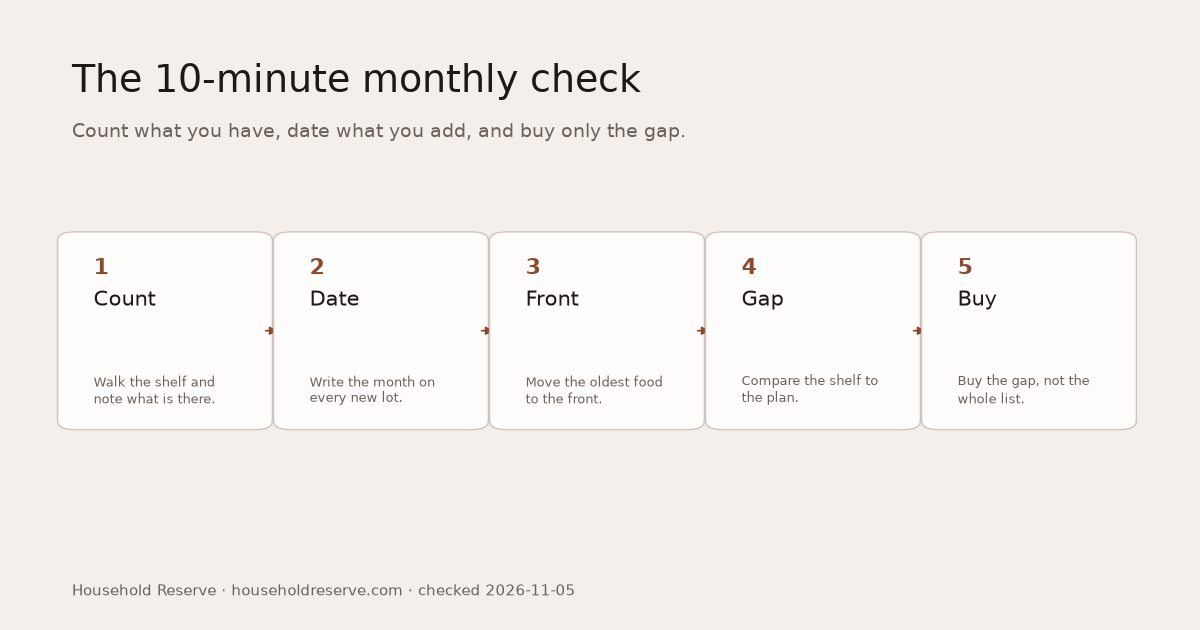
Walk the main shelf and note what is there. You do not need to count every grain; estimate by package or pound and write it down.
Write the month and year on every new lot. If the package already has a best-by date, add the purchase month so you know which one to use first.
Move the oldest food to the front and the newest to the back. Put a “use first” note on anything close to its date.
Use the calculator or the 3-month plan as the target. The gap is what you buy; the surplus is what you eat next.
Add the missing items to the next shopping trip. Do not re-buy what is already in the back of the shelf.
FIFO is the whole system in four words: the oldest food goes first. Date every lot, put new food behind old food, and plan meals around what is close to its date. A shelf you do not rotate is a donation to the landfill with extra steps.
If you store food in more than one place, keep a location column. A can in the basement and a can in the kitchen are not the same inventory. The long-term food storage guide covers containers and shelf life; this page is the monthly habit.
If the whole pantry is too much, inventory one shelf this month. Add the next shelf next month. The point is a repeatable loop, not a one-time audit: count, date, front, gap, buy. A small inventory you actually update beats a perfect spreadsheet you abandon after a week.
Put the sheet where you will see it — inside the pantry door, on a clipboard, or taped to the shelf. The best system is the one that survives a busy Tuesday.
Print this page, or copy the columns into a notebook. Ten rows are enough to start; add pages as the shelf grows.
| Item | Qty | Unit | Location | Best by | Opened | Note |
|---|---|---|---|---|---|---|
Print with your browser’s print command. The site navigation and footer are hidden on paper.
A pantry inventory is a dated list of what you have, how much, where it is, and when it expires. It turns a shelf into a plan: you can see the gap, use the oldest food first, and avoid buying a fourth bag of rice.
Once a month, for about ten minutes. Count the shelf, move the oldest food to the front, note what is close to its date, and write down the gap. A longer check once or twice a year can cover containers, pests, and deep storage.
First in, first out: the oldest food goes in front and gets eaten first. Date every lot when it comes home, put new food behind old food, and plan meals around what is closest to its date.
At minimum: item, quantity, unit, location, best-by date, and the date opened. Add a note for allergens, a “use first” flag, or the meal it belongs to. The list should be short enough to update in ten minutes.
No. A printed sheet on the pantry door works, and it does not need a battery, an account, or a subscription. A spreadsheet is fine if you prefer it; the habit matters more than the tool.
The rotation method is ours; the shelf-life and storage reminders come from USDA and USU Extension, checked 2026-11-05.
| Source | What it establishes | How this page uses it | Checked |
|---|---|---|---|
| USDA FoodKeeper — FoodSafety.gov | Storage times for pantry, refrigerator, and freezer foods. | The best-by and first-eat prompts on the inventory sheet. | |
| USDA FSIS — Shelf-Stable Food Safety | Canned, rice, and pasta storage windows; store below 85°F; check the pantry every few weeks. | The rotation and storage-condition reminders. | |
| Utah State University Extension — Food Storage in the Home | Date and rotate stored food; keep it cool, dry, and pest-free. | The deeper storage and container notes. |
Last updated: